Music & Interview
Mark Reeder
Introduction:
Mark Reeder: representative of Joy Division’s label Factory in the 70ies; manager, producer through the decades; founder of MFS Records in the 90s … We already interviewed him years ago.
Read here.
Interview:
Hi, Mark.
Nice to have you for another interview on NovaFuture Blog.
Actually this interview was planned a long time ago … with a different topic, the release of Die Vision’s Album “torture”. Unfortunately this project was stopped and the planned album is still unreleased. In the meantime you have made some very cool remixes for New Order and released the nice electronic pop album “Mauerstadt”. So we updated our questions a little bit but kept some of them. Let’s talk about the movie “B-Movie”, your album “Mauerstadt” and check out how it was working on the Die Vision album during the fall of the iron curtain.
In last interview you said that you became the representative of Factory Records, the label that signed Joy Division, in Germany because you already lived in Berlin. This story and many other funny anecdotes are portraited in “B-Movie”. The movie became very successful – a lot of international screenings etc. It also has a very good soundtrack incl Westbam feat “You Need The Drugs” and your track “Mauerstadt”. How much of the stuff of “B-Movie” is true and how much … the phantasy of the film maker? What was your part during the movie production? Was you involved in the track selection for the soundtrack album? What is the idea behind the track “Mauerstadt”?
Actually, it is all true. It’s just that we had to find parts of my story to which we had film footage for. The film is only about my time spent in West-Berlin, because West-Berlin is forgotten. Virtually everything I experienced in East Berlin had to be left out, all except the Toten Hosen gigs. Mainly, this was because we had no film footage from my escapades in the East. Some parts were changed slightly, or adapted to fit the flow of the narrative, as we had to compress 10 years into 90 minutes, so we couldn’t go into deeper detail, such as Nick Caves initial reaction to my flat, which was a 22 sq meter hinterhaus hovel in Kreuzberg, with a coal oven heater, no hot water, no shower and an outside toilet. Nick said it was like living in the Victorian age.
One huge part of my life which also had to be omitted, was going every weekend to the Metropol Theatre on Nollendorfplatz, in the 80s it was Europe’s biggest gay disco. The Berlin birthplace of HiNrg. No one filmed there, ever, so we couldn’t include it in my story, as we had no footage and so we had to make do with Westbam to represent the flourishing dance scene (who was also one of the Metropol DJs).
The selection and running order of the B-Movie soundtrack album was made by Edel and Klaus Maeck. I had absolutely nothing to do with that, I was only asked at the last minute to make a mix of all the tracks which didn’t fit onto CD1. I really wanted to have one of the Neubauten reworks I made on the album, but they wouldn’t license them to us. I also wanted Edel to make it possible for the viewer of the film to be able to access the featured songs in their entirety on the blu ray DVD through seamless branching, this would have enabled the viewer to hear the entire restored soundtrack and also everything in 5.1 surround. After all, I mixed everything (incl Joy Division, Neubauten, Sex Pistols and Malaria!) all in 5.1 surround for the film. It was a missed opportunity.
The idea behind my track Mauerstadt was to make it sound like an 80s track.
I wanted to give the track a simple, dystopian, DAFish kind of feeling by using just a analogue modular synth appregiator, a growling bass guitar and hard, straight, driving drums and a monotone vocal. I added the happy birthday sample from Knut Hoffmeisters super8 film about the Berlin Wall’s 25th birthday party, where everyone is so obviously totally out of it and because it sounds so funny. The long version was released only on the B-Movie vinyl and so I’ve put that version on the CD and the short version, which was on the CD is now on the Mauerstadt vinyl. Some people have actually told me how they remember that track from the 80s.
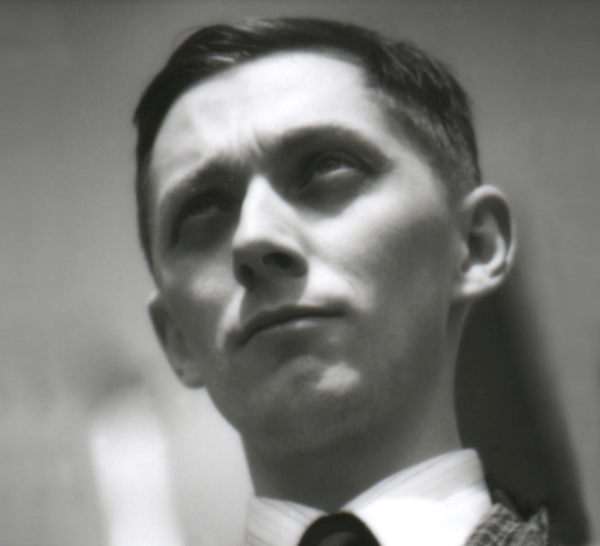 (Mark Reeder in the 80ies)
As shown in the movie you was not only a manager, producer, label head for several acts in West Berlin but also was member of the band “Shark Vegas” that was produced by New Order. Which instrument did you play? What was your role within the band? Why was it produced by NO?
In Shark Vegas I attempted to play guitar, keyboards and operate our Revox B77 which played the drum machines and sequencers. We decided to use a 4 track reel-to-reel tape, because after our illegal gig in Hungary, someone had stolen our drum machine. Our first and only Shark Vegas 12” single You Hurt Me was produced during our New Order European tour by Bernard Sumner. We had a few days off, so we went to Conny Planks legendary studio to record it. That ended up being a total disaster. Conny Plank popped in to the studio once and asked “ok lads?” then he just played table tennis outside with his kids mates, or made lunch. The sound engineer was suffering from a slipped disc and had to shout his instructions between spasms of pain from a small camp bed, which was lying below and in front of the mixing desk. The result was dreadful.
In the end, we went back to Manchester’s Strawberry Studios to finish it! New Order really liked YHM and consequently stole most of our ideas and regenerated them for Low Life. Two different 12” singles were released, one on Totenkopf (the Toten Hosen label) and the other on Factory Records, whch also had the sub-title “… but now your flesh lies rotting in hell”.
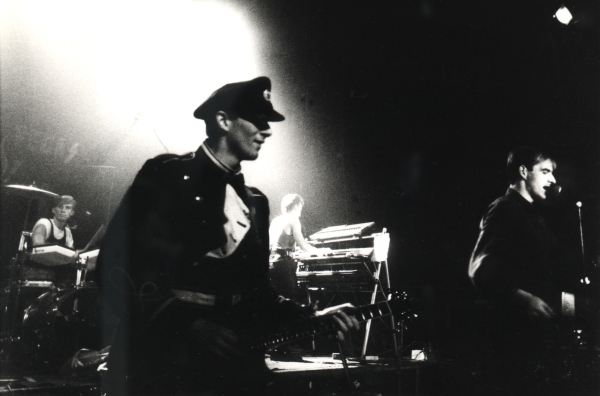
(Mark with Shark Vegas playing live)
New Order just released some nice remixes made by you (there were part of the singles accompanying the New Order albums “Music Complete” and “Complete Music” on Mute). Who came up with the idea to let you remix NO? What is your relationship to New Order nowadays?
My relationship with New Order is as it always was, they are my friends. I wanted to remix Academic for inclusion on my Mauerstadt album, but the band wanted me to remix Singularity and use footage from B-Movie for their live video. I also wanted to make a version of The Game for Mauerstadt too, as I had an idea for it. The version on their album is quite banging and I thought the beautiful lyric doesn’t really get a chance to emerge. Also on Music Complete, there are no slow or quiet songs, so my idea was to strip down The Game, half speed it and feature Bernards vocals. I added a straight throbbing bass guitar and loads of synth strings. This version was performed as a hybrid, during their Sydney Opera House gigs, where they performed with an Orchestra.
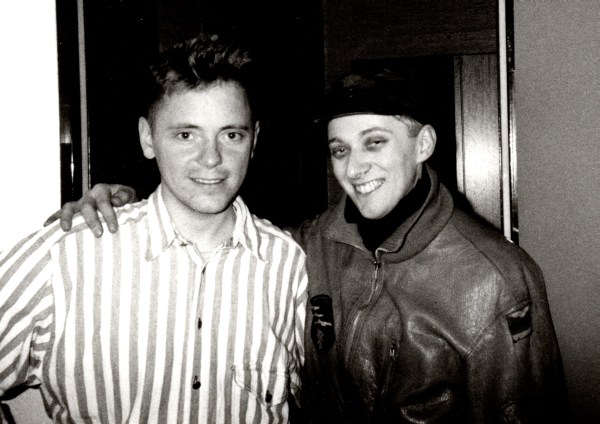 (Mark & New Order’s Bernard Sumner)
We already mentioned it in the introduction: the interview was originally planned for the re-release of Die Vision’s album “Torture”. It is not released yet. What happened? Who is behind the project DV and who was involved in the production of this album? What’s the meaning of the name?
The band and their management basically couldn’t agree and so the project has been shelved until they can. My idea was to release a remastered double album of Torture for its 25th anniversary. As I found my original Amiga tonstudio demo mix tapes from 1989 that I had made before the final mixdown, which took place after the fall of the Berlin wall in early 1990. The band name Die Vision (The Vision) is basically a reference to their favourite band and also a play on words.
I gave the album it’s title because it was torture for us all to make. Not just because of the power surges and restrictions, but because of the political situation. East Germany was literally falling apart as we were making this album. I also designed the album cover too. It featured a painting by Berlin-American artist Cynthia, depicting two black slaves who had each had both their hands cut off, because they didn’t meet their quota of sugar beet. I thought, the Easties all think they had it bad living in communist East Germany, but things could always have been much, much worse. I also wanted to cause a bit of controversy too, by having two black people on the cover and not the band. Who knows, maybe we will manage to make it for the albums 30th anniversary?
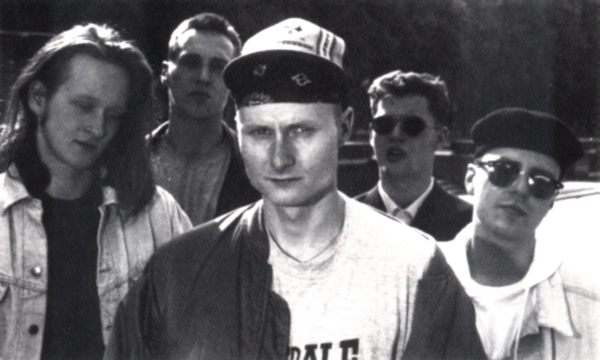 (Die Vision)
The album of DV was the last one that was produced for the GDR label AMIGA. You were in charge of the production. How did you get this job? How did AMIGA work as a record company (production, promotion)? Was it different to the work of labels you worked with or run yourself later?
I was invited by the Amiga to produce the Die Vison album in the latter part of 1989. The band were the only group in the communist GDR (German Democratic Republic) who were officially allowed to perform their songs in English. This was because their singer Uwe Geyer studied English at the Humboldt University. Now to study English there, you had to be perfect at speaking Russian too, remember, as English was the language of the enemy. Initially I was told, the band asked for me to be their producer, no doubt I thought due to my association with Joy Division (probably they thought something might rub off?). In reality, the STASI just wanted to watch over me, very closely. The Amiga had already vetted the bands lyrics and approved them for general GDR consumption, but when it actually came to singing them, they were actually quite un-singable. So I asked my writer friend Dave Rimmer (Once Upon a Time in the East) to help rewrite the lyrics and we gleefully added cryptic and subliminal messages within the texts. The A&R had no idea we had done this and accepted everything as it was, because it had all been previously approved. The Brunnenstrasse Amiga Tonstudio studio was a self-created Frankensteins monster. It was fascinating. Almost everything had been made by the engineers themselves, all except their Neumann microphones, a Fender Strat from 1968, a Steinway Grand piano and a Melotron. The Amiga label was run like a civil service. Thousands of people seemed to work there doing unfathomable tasks. Elderly women reading over the LP cover texts, sat in offices adorned with net curtains, potted plants, pictures of cats and ersatz café. It reminded me more of the tax office than a record label. The words fashionable or trendy didn’t belong within their corridors.
Yet in the studio, the basic production was the same as anywhere else really. Except that we had to deal with regular power fluctuations, which would always result in all the tracks on their self-made 24 track tape machine being erased. It was quite a nightmare. I would be biting my nails every time the lights flickered.
As for promotion, there was no such thing in the GDR. They didn’t really have product advertising and certainly not for records. The Amiga had control of all the record shops throughout the GDR and they all took what they were given.
The album did have huge pre-orders though. After finishing each song, I would make a mixdown for myself on tape, just so I could keep track. The Amiga A&R took a few of these early demo mixes and went around East Germany proudly presenting them to all the record stores, as it was the first East German album ever to be sung entirely in English. Before I was anywhere near finished, we already had 32.000 pre orders for Torture!
Naturally, the Amiga was run nothing like an indie label. They didn’t have to be anything, the Amiga were the only players in East Germany with no competition. After the fall of the Berlin Wall, they changed their name from Amiga to Zong in a pathetic attempt to distance themselves from their communist past. I thought that was a wrong move and proposed they change their name to ZONY, but they didn’t see the irony in my joke and they certainly didn’t understand the power of marketing at that point. Finally, I ended up starting my own label using their facilities – I called it Masterminded For Success. Knowing that the Germans loved to abbreviate everything, I wanted to keep the three letters associated with the official name of the STASI, the Ministry for State-security, or MFS.
 (Mark in 1984 with some equipment)
As we can imagine the equipment in the studios of AMIGA was very different to the machines you knew working with western artists. Which equipment did you use for the album? Was it difficult for you to get into it, to understand how it works? Could you please tell us something about the equipment you used in the 80ies, GDR and nowadays?
As everything in the Brunnenstrasse studio had been made by hand, nothing was like the machines that you saw in a Western Studio. The only recognisable machine was an Otari 24 track, but even that was a deception, as it was only the Otari housing, The interior was a mix of Studer and Telefunken tape machines cobbled together. Their equipment had more or less the same functions, but it all looked self-made. It was quite fascinating. I remember their newly built remote controller that they used to stop and start the recordings on their 24 track machine. It was gaffa taped to an old snare stand and it had a horrific 5 millisecond delay from the moment you pressed the clunky buttons. The studio had a forest of East German Neumann microphones and a few Western amps, like a VOX AC30 or Marshall. All this western stuff had been bought in the late 1960s as part of some five year music production plan. Everything was kept in excellent condition though. They had a room which contained a series of metal coils and spring-like spirals and hanging sheets of metal. These were the reverb plates which could be operated directly from the mixing desk at the click of a gas-cooker style switch. As the drummer of Die Vision quit the band on the second day of recording, I was forced to smuggle a drum machine into the East, as there was only one drum machine in the GDR (a Sequencial Circuits) and that was on permanent loan to the Friedrichstadt Palast Orchestra. Otherwise we had to make do with what was available.
You just released the album “Mauerstadt”. It has the same name like your track on “B-Movie” soundtrack. Is there any connection between these two “things”/releases? “Mauerstadt” is full of collaborations. So you worked with The KVB, Queen of Hearts, Ekkoes, MFU or Maja Pierro on tracks for it. How did you select the collaborators? Or how did these collabs happen? Please tell us also something about the way you work with these artists on tracks we can now hear on the album.
Yes of course the title track is the same (although a different mix) I wanted to feature it more.
As for collaborating, I like to work this way. Share my ideas and thoughts. For example, I had made a remix for Queen of Hearts and then I asked her if she’d like to work on a track together. I ended up writing a couple of songs with her for her album, or I remixed The KVB’s White Walls track and then we wrote In sight together. As for New Order, that came about because I had an idea and wanted to see where it would go. Thankfully, I don’t have to fly over to the UK to record anymore, the modern age allows us to bounce sessions and mixes via the internet. If something needs to be discussed that’s easier too, but mostly the artists just let me get on with it.
 (Mark playing guitar, photo by Micha Adam)
As said, you are from Manchester. Have you still a relationship to the city, music scene there? Any friends from the old days?
Naturally of course, I have family and friends there. I only left Manchester and came to live in Berlin. It’s not that far away, Berlin and Manchester have a strange similarity. I can’t say exactly what it is. Maybe it’s the desperation and thirst for expression and creativity. I’ve performed there a few times recently too. Once for the Manchester International Festival True Faith Exhibition opening in Manchester Art Gallery (I had everyone dancing there in the Art Gallery for the first time, ever). That was great fun and I also performed together with MFU at the iconic Tiger Lounge, (George Best’s old club). That was a wonderful gig. I like Manchester now more than I did when I left, it has become a very cosmopolitan city and I am very proud of it for being able to transform itself like that, but I could never live there again, Berlin is my home.
You are a music nerd. And we love it. Please name 10 favourite records that had/have big influence on your life as person and as artist. Tell us why they had such an impact and what they changed in you.
Errr, thank you Juergen 🙂 Well, that is always such a difficult question to answer. So many different things have influenced me over the decades. It’s not so easy just to pinpoint them to only ten, as it leaves out so many other great things. I will try, but please don’t judge me on this. It’s just what I can think of now…
01. Telstar by the Tornados
This was the first record I ever bought. It was 1962. They only played it once on the radio each day and I wanted to hear it again and again and again. I pestered my mother so much she dragged me down to our local record shop (Rumbelows in Denton) and made me buy it. I guess that moment started my record buying addiction. After that, we bought all kinds of records mainly 7” pop singles, by The Beatles, Shadows or Cilla Black and that tradition of buying singles followed me into the 70s with punk. In my opinion, Telstar is the first techno record. It’s dancy, melodic and instrumental.
02. Dr Who Theme by Delia Derbyshire & the BBC radiophonic workshop
This was the first electronic music I ever heard. A brilliant theme. Still mysterious and captivating to this day. As a child, I had no idea how it had been made, but it sounded so futuristic.
03. Electric Ladyland by Jimi Hendrix
The first album I ever bought with my own money. I knew Jimi Hendrix from the telly, he was the flamboyant black guy who played the guitar with his teeth. I heard this album regularly during weekly visits to Manchester’s record shops with my elder cousin and I think I only wanted to listen to it because of the naked girls cover. Each time I heard it though, it sounded different, I wasn’t aware it was a double album. I was determined to own this album for myself. So I plotted a plan to buy it. To accumulate the money, I’d do odd jobs like getting bread, groceries or 20 Park Drive cigarettes for the old age pensioners who lived across the road and they always told me to keep the change. One Saturday, I secretly went into Manchester on my own, I remember it was a very cold day. I was a bit scared going into Rare Records on my own. I bought the album (which was very expensive for a ten year old boy) and I smuggled it home. Petrified it would be discovered, I hid the record sleeve in a box under my bed and never told anyone about it until I was about 16, as I knew if my mum saw it, she’d have certainly thrown it out.
04. Switched on Bach by Walter Carlos
This was the first record I ever heard on a Stereo. My cousin wanted to buy a second hand stereo and so one afternoon we went to some blokes house. There was this huge Stereogramme monster, like a sideboard, lumped in the middle of the room. To demonstrate the wonders of his stereo, he put on Switched on Bach. I’d never heard anything like it. I was fascinated. What was that sound? It was like Dr Who. My cousin didn’t buy the stereo, but once he got one, I would be glued to the thing listening to stereo records by King Crimson, Pink Floyd and The Crazy World of Arthur Brown.
05. Fireball XL5, Stingray, Capt Scarlet, UFO & Thunderbirds scores by Barry Gray
This was the music that got me into soundtracks. Barry Grays scores were always very dramatic and memorable. He mixed electronics and orchestra to create other-worldly soundscapes for Gerry Anderson’s futuristic sci-fi puppet series. It took over 45 years for the music for these TV series to be released.
06. Roxy Music by Roxy Music
Virgina Plain was the record that kicked off the glitter era for me. They sounded so different from all the other bands of the time and used a fusion of synths and rock. This album looked and sounded like no other. It was also around this time that I also discovered the sounds of German Electronic music too, like Cosmic Jokers, Neu and Kraftwerk which set me on a path to discover more music from Germany…
07.Low & Heroes by David Bowie
Although I loved the Ziggy Stardust and Hunky Dory albums, these two albums recorded in Hansa studios, changed the sound and image of David Bowie and I have to say, they probably influenced my decision to visit Berlin. Low was this dystopian, dark and very Krautrock sounding album, which Bowie followed up rapidly with Heroes. Heroes was a little more accessible, but it still sounded amazing. I got the German edition of the album where Bowie sings Heroes in Germanese.
08. An ideal for living/Unknown Pleasures & Closer by Joy division
More than any other, this was the band and album that changed everything in my life. After moving to Berlin, I became Joy Divisions representative in Germany. Then when Tony Wilson formed Factory Records, I automatically became the representative for his label too. The first Joy Division single actually sounded pretty dumpf and so Rob decided to repress it as a fashionable 12”, it still sounded dumpf, but now it was louder. It was only when they went into the studio with Martin Hannet did everything change for the band. They stopped being a ropey punk band and became something entirely different. Their debut album sounded like no other and with Peter Saville’s simple pusle-wave design it looked like no other too. In every aspect, it was light years ahead. Mixing synths and guitars and sound effects, all held together by Ians heart-wrenching poetry. Martin had gained his experience mixing iconic records by Manchester’s punk bands like The BuZzcocks, but realised he could do so much more with Joy Divisions music. I thought everyone must now realise that this is the best band in the world, but in reality, no one was interested. I managed to convince Rob to bring the band to Berlin, as I thought if they saw them, the Berliners would love them. Sadly, only a handful of people came to see Joy Division perform at Berlin’s Kant Kino. I was devastated, but the band didn’t care. This was normality for them, and they were just happy to be in Berlin, to finger the bullet holes and eat schweinshaxe. Of course, my friendship with the band continued after Ian’s death and still continues to this day.
09. Violator by Depeche Mode
Although I have followed this band from their inception, this album was like a revelation. I already knew Francois Kevorkian’s previous work, as I was heavily into underground dance music during the 80s and Francois Kevorkian was my favourite remixer. I tried to buy everything he made, yes, even his remix for Diana Ross! His legendary mixes for the Prelude label (such as Sharon Redd’s Beat the Street) and Kraftwerk set him above everyone else and he has without doubt been a huge influence on my own work. When he teamed up with flood and Depeche it was almost like a dream come true. And he didn’t disappoint. Violator is his masterpiece.
10. Perfect Day by The Visions of Shiva
This record was the first international success for my label MFS. Admittedly, my initial idea was to start a label as a musical platform for Eastie Techno kids, but as they all had no money, no equipment and no experience, I had to fall back on musicians from West Berlin. I had a rough idea about how I would like the music to sound on MFS, and so when I heard Cosmic Baby was looking for a new label, I met him and proposed my concept: To make a more hypnotic, melodic and emotional sounding style of Techno. I liked his interpretation and we released his first single Cosmic Trigger under the moniker MFS Trance Dance. The DJ’s loved it, but said they couldn’t play it because apparently, it wasn’t DJ friendly. I suggested to Cosmic that he look for a DJ to work with and eventually at one of his gigs, he met a young warm-up DJ called Paul van Dyk. Paul appeared to be a nice lad and so I put them in the studio together. The result was Perfect Day. This record went through the roof! Their second release How much can you take? was even more successful, but then came the clash of egos. Paul had his own success with his remix of Humate’s Love Stimulation and Cosmic wasn’t having any of it. They soon split up and eventually, after sequencing our first MFS compilation Tranceformed from Beyond together with Mijk van Dijk and his own hugely successful album Stellar Supreme, Cosmic left MFS for the allure of stardom as promised by BMG.
 (Mark, photo by Katja Ruge)
“b-movie” including a screening tour are finished, “Mauerstadt” album released… What is coming next? Live touring? On what are you working?
Well, the tour with B-Movie is certainly not over. It’s still ongoing. There are many places that have not yet seen it. I’ve actually just returned from a two month tour of China, where I DJ’d, showed B-Movie and gave lectures about electronic music and Berlin in the 80s and I also produced two interesting Chinese bands there, Stolen (from Chengdu)
https://www.youtube.com/watch?v=RVmUZZ_2pgc and Hang on the Box (from Beijing).
Apart from preparing everything for the release of my Mauerstadt album (which is available on CD, DWLD and a limited edition double white vinyl),
I’ve already started work on my next album too. I have just finished a song with an old DJ friend from Ireland John Gibbons, and a new song with MFU, and I recently remixed Vicious Games for Yello.
These tracks will be included on my next album, which will be released early next year.
Thanks for this interesting interview
You are very welcome, Juergen.
Recommendations:
Mark Reeder album “Mauerstadt”
compilation “Collaborator”
compilation “Five Point One”
New Order’s single “Singularity” w/ Reeder remix
Exclusive Mix:
Tracklist of Exclusive Mix:
01. Delia Derbyshire & the BBC Radiophonic Workhop – Dr Who (original 1963 theme)
02. The Tornados – Telstar
03. The Cure – Purple Haze
04. Say Lou Lou – Maybe You
05. The KVB – Fixation
06. Visions Of Excess – Object To Be Destroyed
07. John Foxx & Steve d’Agostino – Impenetrable
08. Blank & Jones feat. Elles de Graaf – Mind of The Wonderful (Mark Reeder’s Mastermind Mix)
09. Margret Berger – I Feed You My Love
10. Stolen – Copy Shop
11. Blank & Jones feat. Bobo – Loneliness (Mark Reeder’s Alone In The Dark Mix)
12. Blank & Jones feat. Steve Kilbey – Revealed (Mark Reeder’s Overexposed Mix)
13. Hang On The Box – Hunting
14. Blank & Jones feat. Bernard Sumner – Miracle Cure (Heilmittel mix)
15. The KVB – White Walls (Mark Reeder’s Stoned Wall Remix)
16. Mark Reeder- mauerstadt (RIAS Mix)
17. Blank & Jones feat. Vanessa Daou – Consequences (Mark Reeder’s Resultant Mix)
18. New Order – The Game (Mark Reeder spielt mit-edited Version)
Websites:
Mauerstadt Website
Mark Reeder


