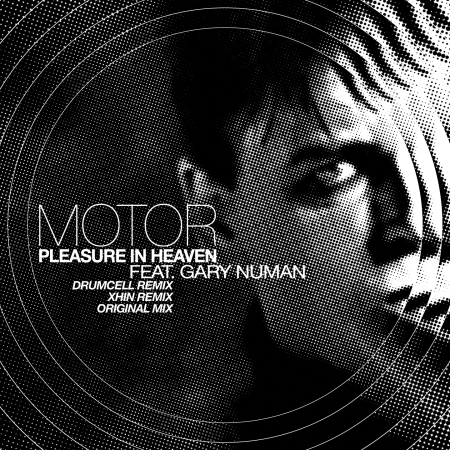
Tracklist: 01) Pleasure In Heaven (Drumcell Remix)
02) Pleasure In Heaven (Xhin Remix)
03) Pleasure In Heaven
Tracks 3 is digital-only.
Info:
Another limited edition picture disc with brand new remixes of the latest MOTOR single, taken from their recent milestone album “Man Made Machine” is coming out on CLRX. The featured vocalist on this fourth edition of the series is none other than Gary Numan, a true legend and another undisputed electronic music pioneer. He is equally known for his chart-topping hits in the 70s and 80s as for his signature sound of heavy synthesizer hooks and massively processed guitars who inspired countless acclaimed musicians of our time. MOTOR feat. Gary Numan “Pleasure In Heaven” is an encounter of two generations of gifted electronic musicians and could be considered a little piece of electronic music history itself.
For this challenging task the Singaporean dj/producer Xhin and the South Californian Drumcell, two cutting edge techno artists have been called on the remix duties and have delivered highly powerful and thrilling versions of this song. While Xhin uses Gary Numan’s vocals predominantly as atmospheric elements, enriching and enchanting the deep and driving track, Drumcell’s mix is almost like an alternative full vocal mix with a slow and mesmerizing yet raw and uncompromising approach.
Supremely honoring the innovative techno roots of MOTOR, both versions show a lot of the artist’s outstanding production skills and complement one another perfectly in their dissimilarity. Apart from the strictly limited collector’s item picture discs, CLRX4 is also available as digital downloads in all the popular online shops.
Listen:
Unofficial Video:
“Pleasure In Heaven (Original Mix)”
Press Info (English):
While the Western world celebrates Jean-Jacques Rousseau’s 300th anniversary, Gudrun Gut, too, appears to be drawn “back to nature”. Yet what a misapprehension that would be. Although nature plays a major role on Gudrun Gut’s first album release since her outings with the Greie Gut Fraktion in 2009, “Wildlife” does not portray nature as a cosy ur-idyll, but rather as a realm filled with rough tenderness and its very own dangers. Nature is where the unforeseen might happen and new sights are set on the in- and exterior. In this spirit, “Wildlife” is no gesture of severance (“Okay, I’m off to the countryside!”), but rather one of biographical continuity via new means. After all, Gudrun Gut – in her guise as Berlin post punk activist, label owner, radio presenter or party promoter – has always been interested in gaps, niches and risky locations. Now, nature itself provides such a small and utopian niche; a place where “it” might happen in a very existential sense.
All of the album’s tracks took shape in Gudrun Gut’s Uckermark hideaway, an hour or two away from Berlin. During production, in autumn and winter, this landscape exudes an almost eerie calm, suggesting that the outside world’s hectic universe of data and projects is no more than a figment of our collective imagination. Gudrun Gut took this silence in her stride – it did not make her nervous, but free, focused and productive. The Uckermark’s woods, fields and meadows foster a unique sense of immersion (see cover), one that becomes tangible in Gut’s vocal performance: As if she was circling an empty centre, as if she grew apart from her being only to rediscover herself, Gut sings about those ephemeral states between enchantment and reverie.
At the same time, she is aware that beauty may be accompanied by emptiness and that even the most luscious garden may soon have to wither away. Far removed from hippiesque humanism, Gut’s natural states are much closer in spirit to the cool knowledge of punk and its successors: Her cover portrait, splashed across the recent new edition of the punk/new wave oral history “Verschwende deine Jugend” (Waste your youth), explicitly references this rich prehistory.
Gut’s music follows a similarly unrushed path; it is allowed to grow and ramify in its own time until it reaches the opulent abundance referenced in the haunting lyrics of the album’s 12” outtake “Garten”. With the sangfroid and serenity of three decades of active music experience, between completely ingenious and utter dilettante, Gut now ventures into a lavishly proliferating world of sounds and references. While the opener “Protecting My Wildlife” confronts us with jarring post techno minimalism, “Garten” soothes the ear with its charmingly shuffling electric romance. Soon enough, however, well-trodden paths are left behind: Gut’s reworking of “Simply The Best” turns this hackneyed mega hit into a staggering love ballad; a streaky guitar adds further distortion. “How Can I Move” seems to hide a trace of Armand van Helden in the underbrush; “Mond” flirts with subtle Detroit techno allusions. The distinctly dark “Tiger”, on the other hand, truly does sound like a veritable tiger leap into the past: Here, Gudrun Gut apparently digs below her own feet. Similarly free of nostalgia, “Erinnerung” looks back to the past with a string of words created in a lyrical back-and-forth ping-pong match between Gut and author Annika Reich; words that deal with ageing, among other things. We were all there at the time – but why do we all tell a different story? It is these biographical nuances that stand out when compared with Gut’s last solo album “I Put A Record On” from 2007. All tracks were mixed together with Jörg Burger at two studios in the East and West.
Time and again, the album exudes a lascivious and demanding intimacy that comes into its own on the fantastic “Frei Sein”. Here, the track turns a nursery rhyme’s playful naivety into an idiosyncratic anthem with African-inspired rhythms and a clicking animist ambient sound. “Frei Sein”, i. e. being free, is what Gudrun Gut is all about. To her, freedom goes far beyond the artistic realm. Like this album, it is the utmost promise “full of kisses” and “full of joy”. With only the odd bee sting to bring us back down to earth.
Aram Lintzel
Press Info (German):
Die westliche Welt feiert Jean-Jacques Rousseaus 300. Geburtstag und auch Gudrun Gut scheint sich „zurück zur Natur“ zu sehnen. Was für ein Missverständnis das doch wäre. Auf „Wildlife“, Gudrun Guts erstem Album seit den Veröffentlichungen mit Greie Gut Fraktion 2009, ist Natur zwar ein großes Thema, aber eben nicht als behagliche Uridylle, sondern als Welt rauer Zärtlichkeiten und eigener Gefahren. Natur ist der Ort, wo Unvorhergesehenes geschehen kann und neue Blicke nach innen und außen gerichtet werden. Es geht also nicht um eine Geste des Bruchs („Leute, ich zieh aufs Land!“), sondern im Gegenteil um biografische Kontinuität mit neuen Mitteln. Denn schon als Berliner Post Punk-Aktivistin, Label-Macherin, Radio-Moderatorin oder Party-Organisatorin war und ist Gudrun Gut immer an Lücken, Freiräumen und gefährlichen Orten interessiert. Die Natur kann so eine kleine utopische Nische sein, ein Ort, wo ‚es’ passieren kann, in einem ganz existenziellen Sinn.
Die Stücke des Albums sind in Gudrun Guts hydeaway in der Uckermark entstanden. Während der Produktionsphase in Herbst und Winter herrschte dort eine gespenstische Ruhe, bei der das Gefühl entstehen konnte, dass es das hektische Universum der Daten und Projekte da draußen gar nicht gibt. Die Stille hat Gudrun Gut offenbar nicht nervös, sondern frei, konzentriert und produktiv gemacht. Dass die Wälder, Felder und Wiesen der Uckermark eine ganz besondere Form der Selbst-Versenkung ermöglichen (siehe das Cover), merkt man schon daran, wie Gut ihre Texte vorträgt: Als kreise sie um eine leere Mitte, als werde sie sich selbst fremd und entdecke sich dabei neu, singt Gut von Zuständen zwischen Entrückung und Verzückung. Doch weiß sie immer, dass wo Schönheit ist, Leere sein darf, selbst der üppigste innere Garten kann manchmal verdorren. Mit kitschigem Hippie-Humanismus haben Guts Naturzustände jedenfalls nichts zu tun, viel eher mit dem coolen Wissen von Punk ff.. Das Gudrun Gut-Foto auf dem Cover der kürzlich erschienenen Neufassung der Punk/New Wave-Oral History „Verschwende deine Jugend“ erinnert ausdrücklich an die reiche Vorgeschichte.
Auch musikalisch wird nichts überstürzt, alles darf in Ruhe wachsen und im Überfluss vorhanden sein. Der Text der Maxi-Auskopplung „Garten“ berichtet eindringlich davon. Mit der Gelassenheit aus über 30 Jahren aktiver Musikerfahrung zwischen obergenial und dilettantisch hat sich Gut in eine verschwenderisch wuchernde Klang- und Referenzwelt gewagt. Der Opener „Protecting My Wildlife“ konfrontiert uns mit einem schepprigen Post-Techno-Minimalismus, „Garten“ ist eine charmant shuffelnde Elektronik-Romanze. Schon bald werden die bekannten Pfade verlassen, die Bearbeitung von „Simply The Best“ macht den abgenutzten Megahit zu einer taumelnden Liebes-Ballade, die verschlierte Gitarre sorgt für zusätzliche Verfremdungseffekte. Bei „How Can I Move“ meint man, Armand van Helden im Unterholz zu vernehmen, in „Mond“ leise Detroit Techno-Anspielungen. Wie ein buchstäblicher Tigersprung in die Vergangenheit klingt das düstere „Tiger“, Gudrun Gut gräbt hier unter ihren eigenen Füßen, so scheint es. Unnostalgisch zurück blickt auch das Stück „Erinnerung“, dessen philosophischer Text im Ping Pong-Verfahren mit der Schriftstellerin Annika Reich entstanden ist. Das Thema hat nicht zuletzt mit dem Älterwerden zu tun. Wir waren alle dabei – aber warum erzählt jeder etwas anderes von damals? Es sind solche biografischen Zwischentöne, die im Vergleich zu Guts letztem Soloalbum „I Put A Record On“ (2007) auffallen. Kongenial abgemischt wurden die Tracks gemeinsam mit Jörg Burger an verschiedenen Orten in Ost und West.
Und immer wieder ist da diese laszive und zugleich fordernde Intimität, die in dem großartigen „Frei Sein“ zu sich selbst kommt. Aus der verspielten Naivität eines Kinderliedes verwandelt sich der Track in eine spleenige Hymne mit afrikanisch anmutender Rhythmik und einem animistisch klackenden Raumklang. Überhaupt „Frei Sein“, darum geht es Gudrun Gut zuletzt immer. Die Freiheit, die sie meint, ist natürlich viel mehr als eine allein künstlerische. Sie ist wie dieses Album ein maximales Versprechen „voller Küsse“ und „voller Glück“. Nur dann und wann stechen uns die Bienen.
Tracklist CD & LP: CD1-01)
Wir Bauen Eine Neue Stadt
CD1-02)
Die Freude
CD1-03)
Gute Luft
CD1-04)
Ahoi, Nicht Traurig Sein
CD1-05)
Grünes Winkelkanu
CD1-06)
Morgen Wird Der Wald Gefegt
CD1-07)
Deutschland Kommt Gebräunt Zurück
CD1-08)
Hat Leben Noch Sinn?
CD1-09)
Eine Geschichte
CD1-10)
Madonna
CD2-01)
Rote Lichter
CD2-02)
Glücklich Wie Nie
CD2-03)
Kinder, Der Tod (Version)
CD2-04)
Telefon
CD2-05)
Kinder, der Tod
CD2-06)
Aschenbecher
CD2-07)
Gute Luft (Live in Holland 24.1.1982)
CD2-08)
Hat Leben Noch Sinn (Live in Holland 24.1.1982) <
CD2-09)
Herzmuskel (Live in Holland 24.1.1982) <
CD2-10)
Morgen Wird Der Wald Gefegt (Live in Holland 24.1.1982) <
CD2-11)
Ahoi, Nicht Traurig Sein (Live in Holland 24.1.1982) <
CD2-12)
Rote Lichter (Live in Holland 24.1.1982)
Tracklist Bonus 7″: 01) Palais Schaumburg
Die Freude
02) Palais Schaumburg
Leckerbissen
03) Palais Schaumburg
Grünes Winkelkanu
04) Andreas Dorau
Ahoi, Nicht Traurig Sein
Info (English):
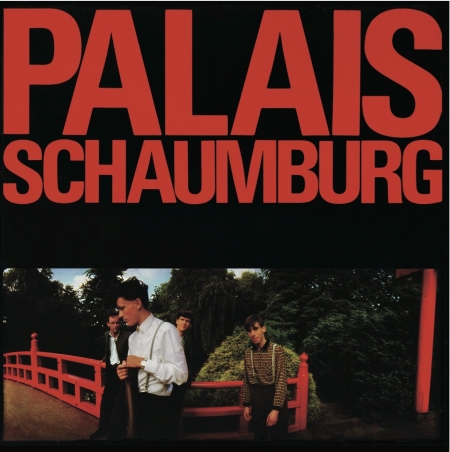
The influential German band Palais Schaumburg has reunited in the classic lineup. Since its release in 1981, their debut album has remained in a league of its own: fleet-footed and peculiar, abstract and pop, amateurish and savvy, it showed real alternatives to the then-pervasive crude search for identity found in the “New German Wave”. The band, which consisted entirely of divergent personalities, has reunited in this formation to rediscover their common ground, further develop, and to perform live.
Their few recent live concerts in Berlin, Cologne, and Tokyo were met with rapturous reception – and not only from those in their own age group. In this post-sampling era, with the current, dynamic changes in the creation and reception of music, their statement has lost none of its fascination. Anyone who sees and hears the combination of idiosyncratic bass riffs (Blunck), bizarre yet catchy rhythms (Hertwig, Blunck), Fehlmann’s shrill horn and synthesizer fanfares, and Hiller’s seemingly atonal staccato guitar work and oblique lyrical conglomerates, will immediately comprehend the influence of this band.
Therefore, we are very pleased to reissue the important original works of Palais Schaumburg in an appropriate and extended format. What do we mean by that? Well, in addition to the actual album, this reissue includes a second CD/LP containing all the pieces that the band recorded prior to their debut album (all of them now for the first time on CD), and a previously unreleased recording of a concert in Holland. The limited edition 180 gram vinyl double LP additionally contains a single with four tracks from a concert in Hamburg where people from the audience – among them Andreas Dorau – perform their own versions accompanied by the band. A lavish booklet includes rare photographs and liner notes by Chris Bohn, editor of the British music magazine “The Wire”.
Info (German):
Die einflussreiche deutsche Band Palais Schaumburg hat sich in ihrer Originalbesetzung wiedervereinigt. Ihr Debütalbum aus dem Jahr 1981 hatte seit seinem Erscheinen definitiv eine Sonderstellung inne: Leichtfüßig und verquer, abstrakt und poppig, dilettantisch und versiert, zeigte es wirkliche Alternativen zur damals verbreiteten kruden Identitätssuche der „Neuen Deutschen Welle“ auf. Die Band, die durchweg aus auseinanderstrebenden Persönlichkeiten bestand, fand sich jetzt in dieser Formation wieder zusammen, um die Anknüpfungspunkte wieder aufzunehmen, live aufzuführen und weiterzuentwickeln.
Bei ihren spärlichen Livekonzerten in Berlin, Köln und Tokio wurden sie dafür frenetisch gefeiert – und zwar nicht nur von Gleichaltrigen. Ihr Statement hat auch in Zeiten von Post-Sampling und den heutigen dynamischen Veränderungen von Musikvermittlung nichts von seiner Faszination verloren. Wer die Kombination aus eigenwilligen Bassriffs (Blunck), bizarren und doch eingängigen Rhythmen (Hertwig, Blunck), Fehlmanns schrillen Bläser- und Synthesizerfanfaren, Hillers scheinbar atonalen Gitarren-Stakkatos und undeutbaren Text-Konglomeraten sieht und hört, dem erschließt sich unmittelbar der Einfluss der Band.
Wir freuen uns daher sehr, die wichtigen Originalwerke dieser Band jetzt in angemessener und erweiterter Form wiederzuveröffentlichen. Was meinen wir damit? Nun, diese Reissue beinhaltet neben dem eigentlichen Album noch eine zweite CD/LP, die alle Stücke enthält, die die Band vor dem Debütalbum eingespielt hat (allesamt erstmals auf CD), sowie einen bislang unveröffentlichten Mitschnitt eines Konzerts in Holland. Die limitierte Doppel-LP in 180 Gramm schwerem Vinyl enthält zusätzlich noch eine Single mit vier Tracks eines Hamburger Konzerts, auf denen Personen aus dem Publikum – unter anderem Andreas Dorau – mit Bandbegleitung eigene Versionen vortragen. Das üppig ausgestattete Booklet enthält seltenes Fotomaterial und einen Begleittext von Chris Bohn, Redakteur des englischen Musikmagazins „The Wire“.
Info (English): The sound of gentrification – Construction noise as cosmic music
This is what results when a delicate musician has to live amidst Berlin’s construction noise for eight years, during the time when the former working class district of Prenzlauer Berg was transformed into a neighborhood for higher-income earners. With his latest album “Construction Sounds” Dirk Dresselhaus aka Schneider TM processes that time, when he was surrounded by constant clatter, noise, sawing, drilling, hammering, chipping, etc.
It happened like this: While improvising at home with his electronic equipment, Dresselhaus at some point noticed that his music was increasingly beginning to imitate the sounds and structures of the construction site noise that surrounded him daily for up to 15 hours at a time and periodically brought him to the brink of a nervous breakdown.
Perhaps as a kind of defense mechanism, he began to record the sounds and patterns produced by the construction workers and their machines, and even began to have fun in doing so. Gradually he had the feeling that the workers, whether consciously or unconsciously, were using their tools much like musical instruments, even interacting, as if they were producing improvised music.
“Construction Sounds” combines these moments with the electronic recordings that Dresselhaus made during this period. He only minimally processed the recordings, as he wanted to make “those beautiful moments, generated by unknown construction workers, which I sometimes even heard as cosmic music” available to a wider audience as faithfully as possible.
Under no circumstances should one confuse “Construction Sounds” with industrial music, which either uses conventional instruments to sound like factory noise (like Kluster in 1970) or uses industrial noises as mere atmospheric or rhythmic additions to music made using instruments, as Einstürzende Neubauten did in the early 80’s. For Dresselhaus, the sounds of construction are the music itself
Important: This album is not a statement, it’s just beautiful music. Anyone delving into these sounds will experience it much like Dresselhaus: From the cacophony, a symphony.
Info (German): Der Sound der Gentrifizierung – Baustellenlärm als kosmische Musik
So etwas kann dabei herauskommen, wenn ein feingeistiger Musiker acht Jahre lang im Berliner Baustellenlärm wohnen muss, und zwar in einer Zeit, in der aus dem ehemaligen Arbeiterviertel Prenzlauer Berg ein Bezirk für Bessserverdienende wurde. Dirk Dresselhaus aka Schneider TM verarbeitet mit seinem neuesten Album “Construction Sounds” ebendiese Zeit, in der er von permanentem Rattern, Rauschen, Sägen, Bohren, Hämmern, Splittern etc. umgeben war.
Und das kam so: Beim heimischen Improvisieren mit seinem eletronischen Equipment bemerkte Dresselhaus irgendwann, dass seine Musik immer häufiger die Sounds und Strukturen des Baustellenlärms imitierte, der ihn täglich bis zu 15 Stunden am Stück umgab und der ihn in regelmäßigen Abständen an den Rand eines Nervenzusammenbruchs brachte.
Gewissermaßen als Selbstschutz begann er, die Sounds und Patterns, die die Bauarbeiter und deren Maschinen erzeugten, aufzunehmen, und er entwickelte sogar zunehmend Spaß daran. Irgendwann hatte er das Gefühl, dass auch die Arbeiter, ob bewusst oder unbewusst, ihre Werkzeuge wie Instrumente verwendeten, ja sogar mit deren Hilfe interagierten, so als produzierten sie improvisierte Musik.
“Construction Sounds” verbindet diese Momente mit den elektronischen Aufnahmen, die Dresselhaus in dieser Zeit gemacht hat. Seine Aufnahmen hat er nur minimal bearbeitet; er wollte “diese wunderschönen Momente, erzeugt von unbekannten Bauarbeitern, die ich manchmal sogar wie kosmische Musik empfunden habe”, möglichst originalgetreu einem breiteren Publikum zugänglich machen.
Auf keinen Fall verwechseln darf man “Construction Sounds” mit Industrial-Musik, wo entweder mit herkömmlichen Instrumenten Töne produziert werden, die sich wie Fabrikgeräusche anhören (wie es etwa Kluster 1970 getan haben) oder wo gezielt Industriegeräusche als bloße atmosphärische oder rhythmische Anreicherung von Instrumentenmusik verwendet werden, wie es etwa die Einstürzenden Neubauten Anfang der 80er taten. Für Dresselhaus sind die Geräusche der Baustellen die Musik selbst.
Wichtig: Dieses Album ist kein Statement, es ist einfach nur schöne Musik. Wer sich darauf einlässt, dem wird es ähnlich gehen wie Dresselhaus: Aus der Kakophonie wird eine Symphonie.
Info:
Originally taken from her recent album by the same name, Sweet Silence is the title track of Barbara Morgenstern’s brand new EP on monika enterprise too: the Silence Sweater EP which features 4 exlusive versions of the song including 2 remixes and a choral adaptation.
The remixes come courtesy of Shitkatapult founder T.Raumschmiere aka Marco Haas who also mixed the Sweet Silence album. Indeed he clearly knew the subject matter really well cause his two new remixes are the perfect interpretations. While his latest project SHRUBBN! Is a move towards a more experimental sound, Raumschmiere proves he still knows exactly how to fire things up for the dancefloor with these smashing two remixes.
Morgenstern has been leading her choir the Chor der Kulturen der Welt (Choir of World Cultures) for almost 5 years now. And the HKW house band have really found their voice on this beautiful choral rendition “Sweet Singing”. The musical arrangement is also perfectly sparse and fuses harmonically with the choir’s tender strains.
Barbara rounds off the EP with a special extended mix of her new records title song. Its lifting rhythm and crisp electronic production combine with Morgenstern’s upliftingly melancholy lyrics sung in that personal pop tone of hers and all come together to make a powerful culmination. Sweet Silence is no less than the 6th album by Berlin based musician Barbara Morgenstern. Like the Tremeloes, Morgenstern knows just how sweet silence can be. And certainly the extended play is as sweet as the album: this is one Silence Kid you’ll wanna hear more of!