Press Info:
Following his triple volume NEL project for EPMmusic, the UK musical innovator and techno beatmaster, Cristian Vogel returns to the label with ‘The Misty Quay’.
‘The Misty Quay’ is a reference to one of Vogel’s favourite spots in Copenhagen – a little cafe at a small dock on Refshaleøen. While sitting there one time he wrote the following:
“At dawn I get drawn to a Misty Quay where all music seems to be flowing out to sea. I stand on the dock and listen deep, but I’m distracted by some cats hanging out at the jetty. They been out all night. They laugh and bite so much so full of life I wonder if they might live forever. Sudden birds sporting wind swept manes, fly into the acoustics under the concrete docks their tiny roars trace the shape of things faster than data or money. Under the surface, reeds sway and fish sing about legless heroes who got caught up in things – jellys drift in admiration of their mycelial cousins spreading promiscuously deep underground. I consider the whole as I sup a Velvetini. Guess it’s about time. Sirens sounding. Abandon ground dive into the din.” – Cristian Vogel, Copenhagen 2019
Delve further into this landscape across the five tracks on this stunning techno EP.
Track 7 & 8 are not on vinyl / track order is also a bit differnt.
Press Info:
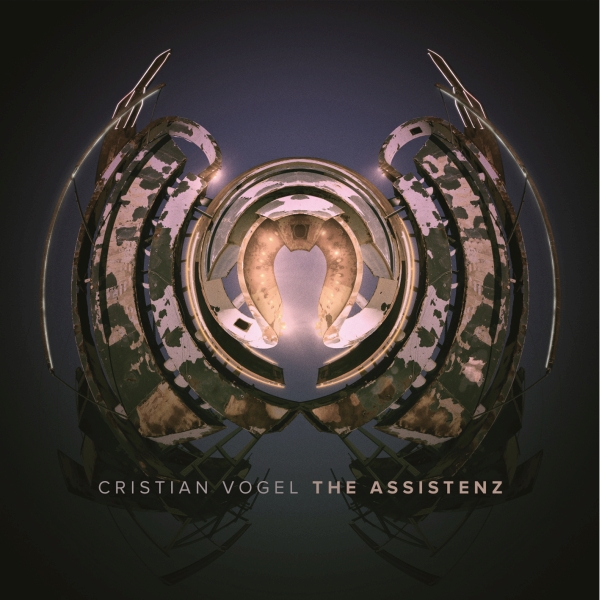
THE ASSISTENZ is the culmination of a four year creative hot streak as vivid as any part of CRISTAN VOGEL’s long career. The trio of dancefloor-oriented records formed by 2012’s The Inertials, 2014’s Polyphonic Beings and now THE ASSISTENZ are sensual pleasures first and foremost: a lifetime of study of frequencies and rhythms on the frontline of the world’s clubs has been put into the creation of sounds that interface with the nervous system and emotional responses with extraordinary immediacy. But there’s much more too: together with the more abstracted album Eselsbrücke, these form an enticing sonic narrative, encoded themes running through them, each part revealing more about the whole. THE ASSISTENZ, then, is many things: a personal document, a tribute to Copenhagen where it was recorded and after whose famous cemetery it is named – but also the final piece in this bigger puzzle, which unlocks untold secrets from the previous three records.
There’s a deeper history, of course. CRISTIAN’s productions going back to the start of the 1990s have woven their way into the fabric of underground culture. His own recent remasters of his early albums, and the Sub Rosa Classics 1993-1998 collections have shown just how potent his early work remains. But his new work exists in a very different world to those past works, and is far removed from the recent electronic generations who he has influenced too. In fact, as you listen to THE ASSISTENZ, you realise that there’s no point making comparisons with other electronic producers at all. While you will certainly hear some of the most fundamental and enduring vectors of underground music – dub, electro, acid, funk – flowing through the tracks, even those things are rebuilt from the molecular level, created completely afresh with new, precise, but somewhat skewed vision.
CRISTIAN’s understanding of music now is spectral. That is to say, with every step through his exploration of sound over the years, he has made more and more detailed analyses of the specific frequencies that make up specific sounds and produce specific effects on the human mind and body. And as a result, his own sound synthesis – increasingly done via the Kyma programming platform – is more and more able to reach beyond the “synthetic” and impact in uncanny and wonderful ways. The most obvious sense of this is the way his sounds touch on the human voice: not just in the chattering, shimmering, singing tones of THE ASSISTENZ’s ghostly centrepiece “Barefoot Agnete”, in the alien radio signals of “The Merman’s Dream” or even in the subliminal “aaah”s hiding in the background of the noisy “Vessels”, but in the way any sound, anywhere in any track can sound peculiarly vocal, heard from the right angle.
And it’s not just the boundary between human and non-human, or that between acoustic and
synthetic, that get blurred to the point of non-existence. CRISTAN’s creative methodology now is all about leaving you so uncertain about where anything came from, or what scale the sounds are operating on, that you have no choice but to let go of preconceptions and standardised critical faculties and go with it. Sometimes that can take you to places where darkness and physicality close in on you as on “Vessels” or “Telemorphosis”, or into haunted spaces on the edge of the void like those of “Snowcrunch” and “Barefoot Agnete”, but even in those, there is euphoria. And in the voluptuousness of “Hold” or the body-rocking funk of “Cubic Haze”, all the abstraction is grounded in the sheer pleasure of your own bodily responses to the sound.
So many of the science fiction dreams of the 1990s are now (virtual) reality. We live in a time when social networks consciously manipulate our emotions, where data is money, where machines learn, where images can’t be trusted, and where the synthetic can feel more real than real. Over some 25 years, CRISTIAN’s experiments have traced much of this weirdness and evolved with it, and his understanding of synthesis and algorithmic processes to create structure makes him one of the most important composers working today. But THE ASSISTENZ doesn’t just experiment with the interfaces between mind, body and machine: it expresses those relationships in ways that are beautiful, troubling, moving and scary, and which even make you want to dance. Together with the preceding three albums it enacts a glorious, endlessly-explorable mapping of just what electronic music can do.
Press Info:
Producer CRISTIAN VOGEL, born in Chile and in raised in Brighton, England, represents the inner turmoil within the history of electronic music and techno. Like only a few other artists such as Aphex Twin, he personifies the second wave of techno during which the concept of authorship, previously pronounced dead, returned in full force. His unique approach to composition gave a distinct touch to his sound, which now finds its place very naturally in the context of the modern music; back then though, it did more than just shake up the concepts of techno. “Complex and intricate rhythms dig deep chasms in dark listening spaces.” (Süddeutsche Zeitung)
In 1996, together with JAMIE LIDELL as SUPER_COLLIDER, he made a final attempt to breathe life into electronic music, which was still primarily seen as dance/rave/club music, and produced clustered break funk music that was so relevant to its time that many considered it more a music of the future: science fiction for the dance floor. Although the project was not a failure, it did not succeed even halfway in meeting the expectations of an artist who was rather perplexed by the lack of interest from others in considering music as art and research. Vogel believes that music has a will to unfold, like a jungle from the undergrowth of industrial cities.
Escaping the rather predictable hedonism of the UK club scene, Vogel moved to Barcelona in 2001 and bound his explosive ideas to the Station 55 studio and labels. He continued to curate networks (No Future, Sleep Debt) whilst at the same time, expanding the horizons for his music, creating outstanding work for contemporary dance, sound art and even his indie-rock group. After a decade of mediterranean experimentalism, Vogel relocated to Berlin in 2012 where he made his first new and daring attempt to assimilate everything that electronic music represented to him, on one critically appraised album: ‘The Inertials’ on SHITKATAPULT. Shortly after, his mystical, floating ambient work ‘Eselsbrücke’ was released, already exploring so many inspirations from his life in the new city.
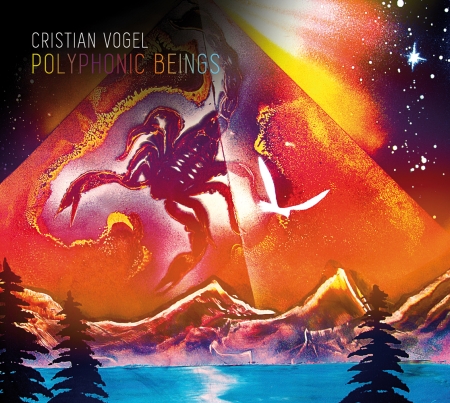
Now in 2014, we present the follow up to ‘The Intertials’ entitled ‘Polyphonic Beings‘ – a true masterpiece in the inimitable Vogel style, as his fans will no doubt agree. ‘Polyphonic Beings’ begins with a surprisingly dub track which twists and turns, the sounds growing darker and more unexpected from track to track, minute by minute. An eerie and unbelievable sound, with all as it should be: every reverb tail, every movement of the fader, every composed note takes the listener piece by piece into Vogel’s own cosmos.
He foregoes interwoven elements for swaying towers of rhythm, powerful sound passages, spaces, roads, mirrors and pathways, leading to a stream of ideas that never wants to end. He aptly quotes Karl-Heinz Stockhausen in the liner notes: These are the „atomic layers of ourselves.“ And so it is. We are what we hear. This is the definitive CRISTIAN VOGEL.
Press Info:
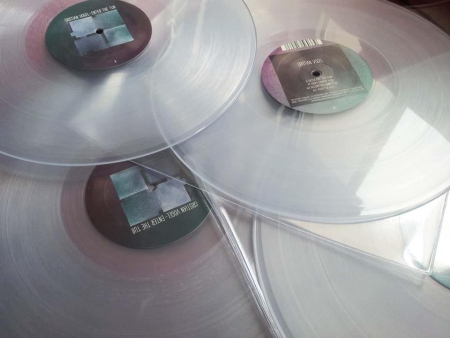
CRISTIAN VOGEL (tresor/nu future…) returns with his 14th studio album THE INERTIALS in june on Berlins Shitkatapult Label. Simultanously Shitkatapult releases a 12” vinyl featuring two club tracks (ENTER THE TUB, LUCKY CONNOR) from the album plus 2 unreleased bonus tracks (DECONSTRUCTIONS, VOIDSTER) to feed and please and beware the club tradition of this outstanding producer. As usual Vogel delivers high end sound and productions of great efficiency, dark poems from the high end. Besides the usual actual and hyped stuff these tracks re-new Cristian Vogel´s art of noize and beat. Cold beauty of clear music.
Press Info:
CRISTIAN VOGEL’s fourteenth album is already a classic. Every track is subtly shaped, full of nuances without drifting into gimmickry. Every sound is efficient and precise. With THE INERTIALS, Vogel nonchalantly provides the soundtrack for industrial wasteland. This is clubmusic beyond any genre which, while bearing the spirit of Industrial Techno, is way above the Rave-dogma which dominated Industrial Techno during the 90s. The dark side of high end production, as you may call it. With a great sense of distinct melody and harmony, Vogel as a producer roughs up the digital surfaces. This is how he adds depth and body to his music, which is something a lot of techno-related productions are lacking. With CRISTIAN VOGEL, digital clarity has patina and at the same time sounds hazy.
At a predominantly moderate tempo, Vogel, a perfectionist, cleverly combines creaky sounds with swinging rhythms. With a knowledge of Dubstep, but unimpressed by the short-lived micro-trends of clubmusic, he has assembled the newest standards of digital production on THE INERTIALS. The lively “Seed Dogs” with it’s unexpected tempo changes; the surprising “Lucky Connor” with it’s marvellously complex rhythm; the hypnotic, incredibly groovy “Snakes In The Grass”, appearing like a confident nod towards Minimal techno; the mysterious “Deepwater”, creating suspense from the very first moment like a John Carpenter soundtrack. The list could be continued indefinitely. Every track is timeless and rests within itself. “Todays Standard Form” is a syntheziser arpeggio fantasy with no beats at all, a prelude for the midi piano, if you like. And with “Dreams Of Apolonia”, dub for the first time is not just insinuated, but actually emerging in it’s own right.
In the late 80s in the U.K., CRISTIAN VOGEL with the “Cabbage Head Collective”, became engaged in the production of electronic music. He completed his studies of 20th century music at the University of Sussex. In the mid-nineties he began to deliver blueprints for Minimal and Wonky techno. His first Album “Beginning to understand” was released on MILLE PLATEAUX in 1994, the following twelve longplayers on labels such as Tresor and Novamute. In collaboration with JAMIE LIDELL, he founded SUPER COLLIDER years before Lidell gained recognition as a solo artist. At the same time, he provided work as a composer of contemporary dance and film music. Vogel did remixes for the likes of RADIOHEAD, MAXIMO PARK, CHICKS ON SPEED and THOM YORKE. As a programmer and theorist in the field of digital sound research he is just as much at home as he is as composer and songwriter.